
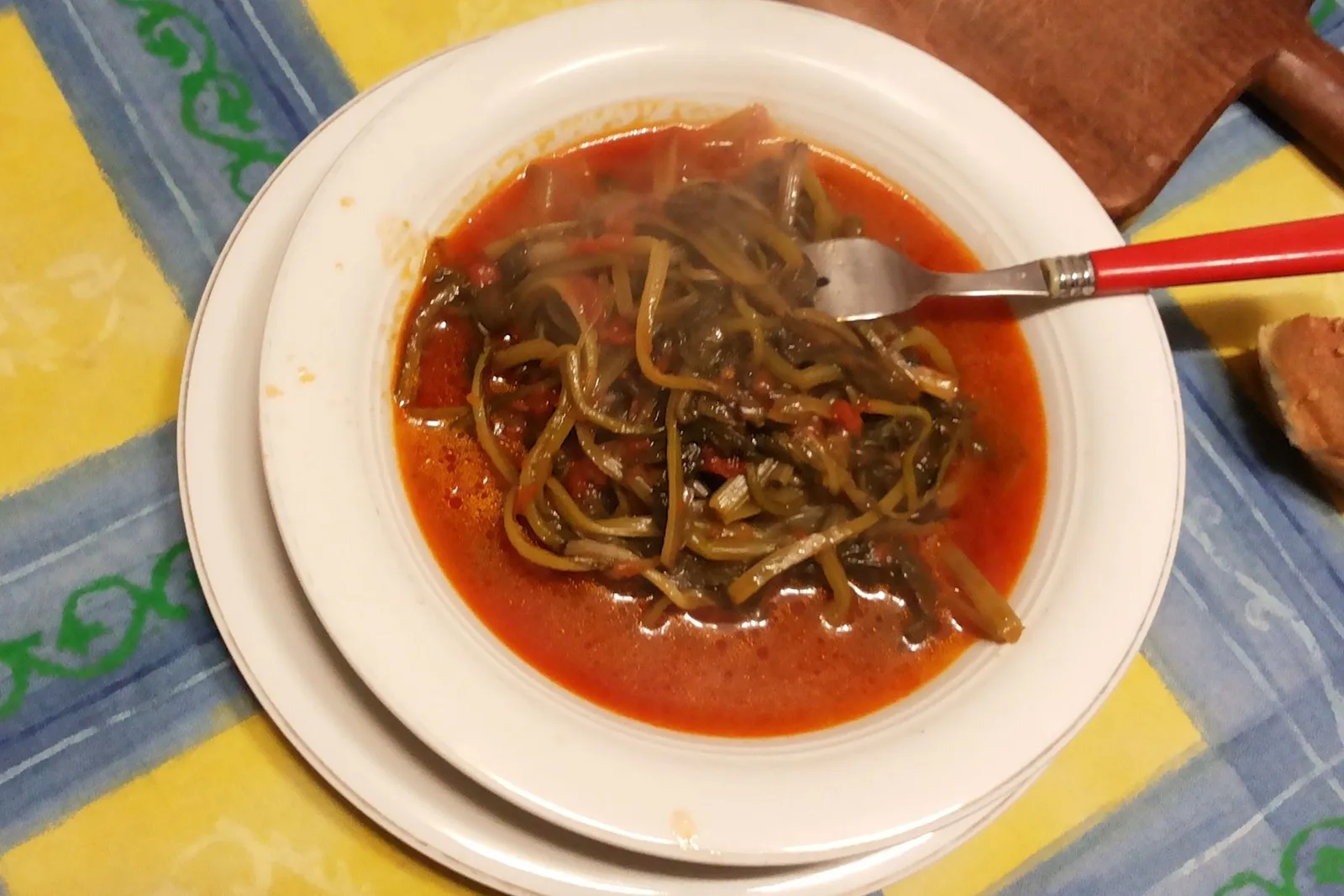
How to cook Swiss chard starts with splitting the bunch. The stems need 5–8 minutes. The leaves need 2–4 minutes. Steam both parts in that same order, or braise them together for 15–20 minutes until the stems yield to a fork. One pound (450 g) feeds 4 as a side.
Swiss Chard Cooking Times
| Method | Heat | Time | Done when |
|---|---|---|---|
| Sauté, stems then leaves | Medium | Stems 5–8 minutes, leaves 2–4 minutes | Stems tender, leaves wilted and bright |
| Steam | Steady simmer | Stems 6–8 minutes, leaves 3–4 minutes | Stems easy to pierce, leaves soft |
| Braise | Low simmer | 15–20 minutes | Stems fully tender, leaves silky |
| Quick boil | Rolling boil | Stems 4–6 minutes, leaves 1–2 minutes | Tender, then drained at once |
How to Prep Swiss Chard
Choose bunches with crisp stems and leaves that are not limp. Red, yellow, and white stems cook the same way. Red stems can tint the pot pink. That color is from the stem, not from overcooking.
Separate each leaf from its rib. Cut the ribs into 1/2-inch (1.3 cm) pieces. Stack the leaves and cut them into 1-inch (2.5 cm) ribbons. Wash both piles. Dirt hides where the stem meets the leaf. One pound (450 g) of whole chard gives about 4 cups of sliced stems and 8 cups of leaves. Keep the two piles separate until the method tells you to combine them.
How to Sauté Swiss Chard Step by Step
This skillet method serves 4.
- Prep 1 lb (450 g) Swiss chard as above. Keep stems and leaves in two bowls.
- Warm 2 tablespoons (30 ml) olive oil in a 12-inch (30 cm) skillet over medium heat.
- Put in the ribs with 1/4 teaspoon table salt (1.5 g) and 2 tablespoons (30 ml) water. Cover and cook 5–8 minutes, until a piece of rib is tender but not mushy.
- Uncover, add 2 sliced garlic cloves, and stir for 30 seconds.
- Add the leaves. Toss 2–4 minutes, until they wilt and turn bright. Taste and add salt.
If you add the leaves with the stems, the leaves are done while the stems are still raw. That is the mistake this order avoids.
How to Steam Swiss Chard
Bring 1 inch (2.5 cm) of water to a simmer under a steamer basket. Put the sliced ribs in first, cover, and steam 6–8 minutes. Pile the ribbons over the ribs and give them another 3–4 minutes. The stems should pierce easily and the leaves should be soft, not gray. Drain, then toss with 1 tablespoon (15 ml) olive oil and 1/4 teaspoon salt (1.5 g).
How to Braise Swiss Chard
Use a 4-quart (3.8 L) pot. Set the pot over medium and warm 1 tablespoon (15 ml) olive oil. Cook the ribs alone for 3 minutes. Then add the ribbons, 1/2 cup (120 ml) water or chicken broth, and 1/4 teaspoon salt (1.5 g). Cover and simmer on low for 15–20 minutes, until the stems are fully tender. Uncover for the last few minutes if you want less liquid. This is the method for mature bunches with thick stems. Baby chard, if the stems are pencil-thin, is better sautéed. It falls apart in a long braise.
How to Boil Swiss Chard
Bring 4 quarts (3.8 L) of water to a boil with 1 tablespoon salt (18 g). Boil the stems 4–6 minutes. Add the leaves and boil 1–2 minutes more. Drain well. Boiled chard is plain, which helps when you are folding it into eggs or grain. Squeeze the leaves gently if a later recipe needs them dry.
How to Tell Swiss Chard Is Done
A cooked stem should not crunch like celery. It can still have a little resistance in a sauté. In a braise it should be soft. The leaves should look wilted and glossy, not brown. If the leaves are khaki and the pot smells sharp, the heat was too high or the pot cooked dry. Add a splash of water next time and keep the burner at medium or low.
Seasoning and Serving Ideas
- Garlic and lemon: finish the sauté with 1 teaspoon (5 ml) lemon juice.
- Raisins and pine nuts: stir in 2 tablespoons (20 g) raisins and 2 tablespoons (15 g) toasted pine nuts.
- White beans: add 1 cup (170 g) drained cannellini beans in the last 2 minutes of the sauté.
- Chili: 1/4 teaspoon red pepper flakes with the garlic.
- Broth braise: use the braise method and serve the stems and leaves with the cooking liquid over rice.
Common Mistakes
- Cooking stems and leaves for the same amount of time.
- Skipping the wash at the base of the stem. Grit ruins an otherwise tender bunch.
- Crowding a small skillet. Use 12 inches (30 cm) for 1 lb (450 g).
- Treating red-stem color as a sign of burning. The tint is normal.
Storage
Refrigerate unwashed chard, wrapped loosely, and use it within 4 days. The stems wilt before the leaves do. Cooked chard keeps 3–4 days at 40°F (4°C). Reheat it to 165°F (74°C). It freezes for 2–3 months. Thaw it in the refrigerator and warm it in a skillet so the water cooks off. Do not freeze it if you want a crisp sauté later. Frozen chard is soft.
Related guides: How to Cook Mustard Greens, How to Cook Turnip Greens, How to Cook Collard Greens: Times and Tenderness, How to Cook Cabbage.
Frequently Asked Questions
How long does it take to cook Swiss chard?
Sauté the stems 5–8 minutes, then the leaves 2–4 minutes. Steaming takes about 10 minutes total. A covered braise takes 15–20 minutes.
Can you eat Swiss chard stems?
Yes. Slice them and cook them longer than the leaves. Throw them out only if they are woody or dried out.
Do red, white, and rainbow chard cook differently?
The times are the same. Red and rainbow stems can color the cooking liquid. The flavor stays mild.
Why is my Swiss chard gritty?
The dirt sits in the folds at the base. Fill a bowl, swish the ribs and ribbons, and lift them out so grit stays behind, instead of running a quick rinse over the whole bunch.
Can you substitute Swiss chard for kale?
You can, with a shorter time. Chard leaves wilt faster than kale. Start checking at 2 minutes. The stems still need their own head start.
Photo: Daniele Pugliesi / Wikimedia Commons, CC BY-SA 4.0, cropped.