
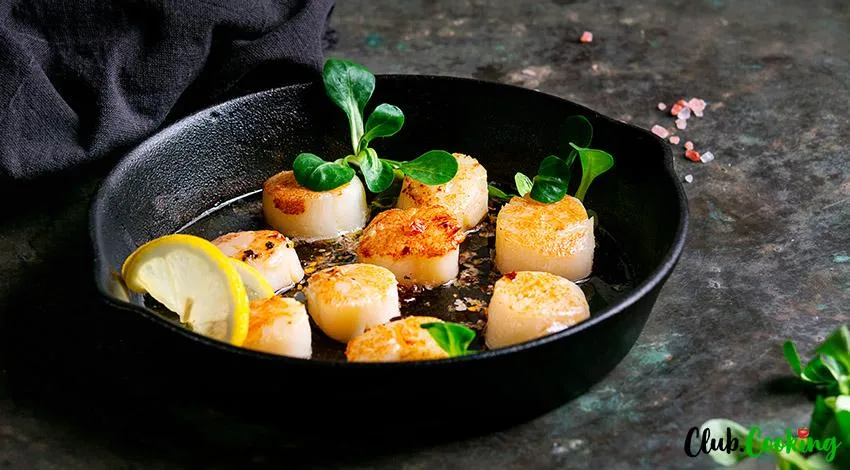
Large thawed sea scallops often take about 3–5 minutes total in a hot skillet. Start checking early, especially with small scallops. The outside should brown, and the center should be firm, pearly, and opaque. Use 145°F (63°C) as the seafood temperature target where you can measure the center reliably.
Scallop cooking comparison
Use the table to choose a complete method, not to guarantee every scallop finishes after an identical number of seconds. A browned outside does not always establish the center’s temperature.
The general FDA guidance is to cook most seafood to 145°F (63°C). It also describes cooked scallop flesh as firm, pearly, and opaque. These are different kinds of information: use a suitable thermometer where practical rather than treating a decorative sear as proof.
Sea scallops, bay scallops, and added water
Sea scallops are large enough to turn individually. Smaller bay scallops cook faster and are easier to toss as a batch. Check the ingredient label for added water or phosphates. Scallops that release a lot of liquid can steam before browning. Dry them thoroughly and work in small batches, regardless of the label.
Thaw and dry safely
Thaw frozen scallops in the refrigerator and drain them. If the package gives special instructions for vacuum-packed seafood, follow those before thawing. Pat both sides dry. Remove the small tough side muscle if attached. Keep the scallops chilled until you are ready to sear, and use a clean plate for cooked pieces.
How to cook scallops in a pan
Heat a thin layer of neutral oil in a heavy skillet over medium-high heat. Add the dry scallops with space between them. Let the first side brown before turning. Start checking large scallops after about 3 minutes total and remove smaller ones sooner if ready. If butter is part of the finish, add it late so it does not burn while the first side sears.
If liquid collects in the skillet, move the next batch to a dry, hot pan or wipe the skillet once it is safe to handle. Give the oil time to heat again before adding the remaining scallops.
Air fryer scallops
An air fryer scallop method needs its own setting, size, oiling, spacing, and turning instructions. Hot circulating air does not replicate direct skillet contact, so the surface may look different even at a safe endpoint.
Use a recipe developed for the appliance and inspect the first batch early. Avoid a deep pile or a container that blocks intended airflow. Follow the manufacturer’s guidance about liners and safe cookware.
Do not infer doneness from the appliance timer alone. Check thick centers and product behavior. If the exterior is drying without the center heating as needed, reassess the complete method rather than simply increasing temperature sharply.
Grill and other methods
Grilled scallops need a suitable grate or skewer setup so pieces do not fall through. Follow the specific grilled scallops method rather than copying the skillet’s surface-contact time.
For a breaded preparation, see fried scallops. Coating color can develop before a large center heats, so maintain safe checks. For smaller pieces, use the dedicated bay scallops recipe rather than treating them as miniature sea scallops with identical timing.
In a mixed dish such as scallops and pasta, coordinate pasta and sauce first so seafood can finish near serving. A long wait in a hot sauce can make correctly cooked scallops firmer.
How to tell scallops are done
Check the thickest scallop. Its flesh should be firm, pearly, and opaque rather than translucent. Where measurable, aim for 145°F (63°C) in the center. Insert a thin probe from the side and avoid touching the pan. Check several if they differ in size. A dark crust can form before a thick center is ready.
Common mistakes
- Applying sea-scallop timing to tiny bay scallops.
- Crowding a wet batch into a small pan.
- Pulling repeatedly before the surface releases.
- Burning butter or garlic during the entire high-heat stage.
- Reducing sauce around already cooked seafood.
- Treating a brown crust as the sole doneness test.
Serving and storage
Serve with a prepared starch, vegetables, or salad that is ready before the seafood. A simple lemon or herb finish can complement scallops without hiding their texture. Keep cold sauces refrigerated until serving and do not use raw-seafood marinade uncooked.
Refrigerate cooked leftovers promptly at 40°F (4°C) or below and use within 3–4 days, respecting any shorter original product limits. Reheat to 165°F (74°C). Scallops can become firmer during reheating, so make manageable portions and avoid repeated warming of the full batch.
FAQ
How to cook scallops in pan?
Pat thawed scallops dry and heat a lightly oiled skillet. Add them in a single layer and wait for the first side to brown before turning. Check the largest pieces first for a firm, opaque center and 145°F (63°C) where measurable. Serve promptly so they do not keep cooking in the hot pan.
How to cook scallops in air fryer?
Use a recipe for your air fryer and the size of scallops you have. Arrange them in one layer so air can reach each piece. Check early, since small scallops finish quickly. Cook until the centers are firm and opaque and reach 145°F (63°C) where you can measure reliably.
How long to cook scallops on each side?
For large thawed sea scallops, about 1½–2½ minutes per side is a starting estimate in a hot skillet. Small bay scallops can need less time. Wait for the first side to release and brown, then check the center after turning. A timer alone cannot account for the thickness or pan heat.
How do I know when it is done?
Look for firm, pearly, opaque flesh through the center. Use a thin thermometer probe to check for 145°F (63°C) if the scallop is large enough. Test one of the thickest pieces. Browned surfaces alone do not tell you whether the center is cooked, especially after a very hot sear.
Does the time change if it is frozen?
Yes. Frozen scallops release water and cook differently from dry, thawed scallops. For the skillet method, thaw in the refrigerator and blot them dry before cooking. If a product is meant to be cooked directly from frozen, follow the package schedule and check the largest pieces for doneness.